December 31, 2025

TL;DR: The mobile home park market has been normalizing to pre-2020 conditions over the last several years. Within this article, we outline the hard data that explains it.
When people call to discuss our services, one of the first questions they usually ask is, “What’s the market doing?” After all, they’re trying to make solid business decisions while sizing up our brokerage.
However, when it comes to consumer sentiment in the mobile home park niche, finding reliable, fact-based statistics can be tricky. That's because unless you rely solely on market perspectives from instatutional park owners, most of the public data, such as loan activity, occupancy trends, and sale trends, is often buried in broader commercial real estate reports rather than being focused specifically on mobile home parks.
Judging purely from social signals, the market certainly feels strong. Mobile home park investing podcasts keep multiplying, and some of the largest MHP-related social media groups now boast over 30,000 members.
But what’s the real consumer sentiment, and how can we know?
Before diving in, I should say I’m not a doom-and-gloom guy. While the details here may run counter to conventional thinking, this article isn’t about suggesting the sky is falling. I’m simply a proponent of presenting honest, transparent facts so buyers and sellers can make informed decisions, rather than relying solely on how the market feels.
About five years ago, while developing our internal Park Sites platform, I stumbled upon what I believe is a reliable way to measure true consumer sentiment in the mobile home park market.
It was 2020, and I was considering whether to build Park Sites for a public offering or pursue other investment opportunities. As a park owner just a few years earlier, I had already sensed the market was shifting around 2017. Back then I had noticed a sharp increase in cold calls from potential buyers. But phone calls alone aren’t hard data, and I needed something more concrete.
What I needed was a method to gauge the actual demand for a mobile home park application. While not perfect, I turned to SEO tools to research website traffic for platforms like mobilehomeparkstore.com and MHVillage.com. After all, visitors to these sites are usually seeking specific information about mobile homes or parks.
The results were eye-opening. From roughly 2010 to 2015, monthly traffic to mobilehomeparkstore.com hovered around 5,000 visitors. Then the trend began to climb sharply—15,000 visitors by February 2020, and astonishing 46,000 by June 2020.
Traffic for MHVillage.com was higher overall, but the trend mirrored the same sharp increase. The message was clear: a surge in market interest was undoubtedly underway.
These fact-based trends ultimately guided our decision to launch Park Sites in 2021. Over the next four years, our site’s traffic followed nearly identical patterns to both sites, just on a smaller scale.
This is where perception and reality begin to diverge.
Below is a graph from SERanking.com, showing the monthly traffic for mobilehomeparkstore.com between February 2020 and December 2025.
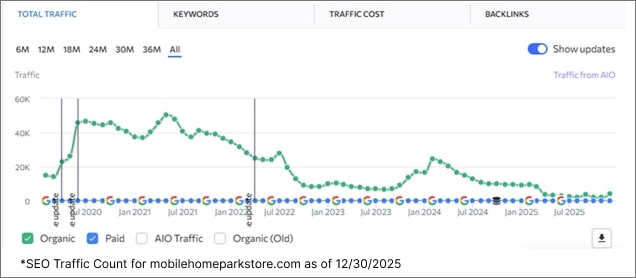
I won’t sugarcoat it: there’s a clear 11-month bubble in visitor traffic, peaking between June 2020 (46,037 visitors) and May 2021 (50,533 visitors), which has been steadily deflating ever since.
Looking year-over-year at the past three Decembers, the decline is striking:
While the traffic numbers differ, MHVillage.com shows a remarkably similar trend over the same period, confirming this isn’t just anomaly for one website. Instead, it’s a market-wide shift in consumer interest.
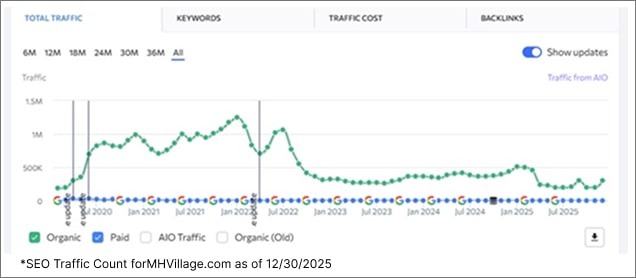
Does this align with what we’re seeing in current market conditions? Unfortunately, yes.
Of roughly 350 public park listings we tracked across 41 states throughout 2025 (ranging in price from $100,000 to $18,500,000 when priced), only about 14 % had verifiable closings by year’s end.
Even when accounting for sales in non-disclosure states, assuming those sales did close, the number only rises to about 17%, or roughly 60 parks.
Let’s be generous: even if the actual number of closings were double what we could verify because of delayed county records, that still equates to only 120 parks (34%) out of 350 listings making it to the closing table in 2025. With numbers like that, it’s easy to see 2025 was definitively a buyer’s market, emphasizing that parks needed to be priced strategically to sell.
Perhaps most surprising: these weren’t long-term mom-and-pop sellers. Based on county records for each listing, an estimated 90–95% of all sellers had acquired their parks between 2018 and 2024.
Based on these findings, it’s easy to assume the downward pressure in the mobile home park market is solely due to higher lending rates. After all, the correlation is clear when you compare visitor traffic for mobilehomeparkstore.com with the 10-Year Prime Loan chart from the Federal Reserve Bank of St. Louis (source).
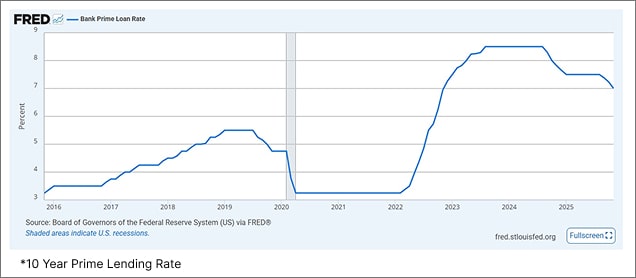
However, having started in the industry, paying 9% on my first mobile home park loan, I believe there’s more at play than just interest rates. In reality, it’s likely a combination of factors that have brought the mobile home park market, at least for now, back to pre-2020 conditions.
Bear with me while I focus on just a couple of major aspects.
If there’s one thing I’ve learned over the years, it’s that any property owner will rarely sell without motivation. As an 54-year-old Gen Xer, I can attest that the thought of retirement can be a powerful motivator after a lifetime of working hard.
According to statistics, in 2017, the average age for Baby Boomers was estimated at 62. While exact numbers vary across U.S. Government sources, there is also clear evidence that between 2015 and 2020, more Boomers were choosing to retire at age 62 rather than wait.
With more Boomers retiring, I believe park owners had a significant shift in attitudes towards seller financing, especially considering the age of the parks they were typically selling.
During this time frame, retirement motivated mom-and-pop owners increasingly viewed short-term seller financing as a smart concession. It allowed them to retire, defer capital gains, and generate a revenue stream from the interest rather than dipping into their savings to make needed repairs and upgrades.
For buyers, starting in 2017 and 2018, this was a major shift. A generation accustomed to low lending rates since 2008 now suddenly had more access to motivated sellers who were now willing to provide favorable financing terms, enabling cash-limited investors to build portfolios with minimal, or even no, up front capital.
But even seller-financed loans eventually come due at some point. Refinancing at higher rates, after using cash reserves from aggressive rent increases to fund capital improvements, often forces investors to rethink their aggressive growth strategies.
Looking at the listed parks we tracked in 2025, 90–95%, were found to be owned by the seller for seven years or less. This makes seller financing, which once fueled the market surge, increasingly scarce.
After all, if a buyer originally financed nearly 100% of a park’s purchase price, it’s unrealistic to expect them to extend similar terms to a new buyer just seven years later.
In the investment world, it’s fairly common knowledge that demand for hard assets, like farmland or commercial property, rises when stock markets feel uncertain.
For many, hard assets are viewed as a safe haven during economic turbulence. Conversely, when market sentiment is bullish, demand for these assets tends to cool.
That doesn’t mean investors stop buying hard assets altogether; it just slows the pace of demand.
As of late December 2025, the Dow Jones posted a five-year average return of 11.05% (Guggenheim Investments). By comparison, of the 350 mobile home park listings we tracked throughout 2025, 108 referenced CAP Rates, averaging 8.55%.
When we look at them side by side, parks represent a clear underperformance compared to the Dow Jones, which returned 14.49% year-to-date for 2025.
For investors with capital looking to maximize investment returns, the choice between buying a hard asset like a mobile home park or investing in the stock market is clear, and has been so for the past few years.
Trend lines and statistics are a funny thing. By design, they cut through feelings and emotion to get to the heart of what’s really happening. In this case, consumer sentiment in the mobile home park market.
While it’s clear that the hot seller’s market that began surging in 2020 has now completely normalized to pre-2020 conditions, I don’t see doom and gloom. I see opportunity!
If I didn’t, I wouldn’t have decided for Mid-Plains Land & Realty to exclusively serve the mobile home park niche, especially after personally watching these trends for the past 4 years.
How strong that opportunity is depends on which side of the closing table you’re sitting on as we head into 2026.
While it may sound cliché, quality parks that are correctly priced for the existing market conditions will always continue to sell, and buyers will generally always gravitate to seller financing options faster.
On the other hand, sellers expecting unrealistic gains after only a few years of ownership, as many did in 2025, may find the market far less accommodating. But those statistics are for another day.
While it may sound obvious, if there’s one clear take away from all of this, it’s that the social hype around mobile home parks isn’t aligning with what the data clearly shows the market is saying.
At Mid-Plains Land & Realty, our role is to help owners and investors make sense of real transaction data, buyer behavior, and pricing trends specific to the MHP niche.
Often, a free consultation with us can provide a valuable market perspective, helping you better evaluate your options, set realistic expectations, and determine the right timing and strategy.
Ready to make a move in the 2026 mobile home park market? Call our office at 402‑615‑9165 for data-driven expert guidance today.

Find this article interesting? Be sure to check out our other recent articles to read about the latest news, events, market insights, and more from the perspective of Mid-Plains Land & Realty.


%20(1).jpg)